· Derek Malone
3 Weighted Jump Rope Workouts (Beginner to Advanced)
Most people quit a weighted rope program in the first week because they start with the wrong intensity. A rope with removable handle weight and a heavier cable changes your shoulder and forearm load the moment you pick it up — so the workout structure matters more than it does with a standard speed rope. These three routines are built around what actually works for our testers and buyers: short, honest intervals that respect fatigue instead of fighting it.
Workout 1 — Beginner: The 10-Minute Interval Starter
If this is your first week with a weighted rope, skip the thick cable entirely. Pull the handle weight insert out, thread the thin cable through, and focus on landing quiet on the balls of your feet. The goal isn't speed — it's staying relaxed through eight short rounds so your shoulders don't lock up.
| Round | Work | Rest | Focus |
|---|---|---|---|
| 1–2 | 30s basic bounce | 30s | Find your rhythm |
| 3–4 | 30s basic bounce | 30s | Relax shoulders, small wrist turns |
| 5–6 | 30s alternate-foot step | 30s | Hip mobility, soft knees |
| 7–8 | 30s basic bounce, faster pace | 30s | Controlled breathing |
Run this exact 10-minute block three times a week for the first two weeks. Once you can finish all eight rounds without needing extra rest between them, swap in the thicker cable for round 7 and 8 only — that's your bridge into the intermediate routine below. Our beginner guide covers common early mistakes like gripping the handles too tight, which tires your forearms faster than the rope itself.
Workout 2 — Intermediate: The HIIT Ladder
The thicker cable that ships with the rope is noticeably heavier through the swing than a standard speed rope — testers describe it as forcing your forearms to work the whole rotation instead of coasting. That's exactly what a HIIT ladder is designed to exploit: short rounds get you moving fast, longer rounds force your grip and shoulders to hold form under fatigue.
| Round | Work | Rest | Style |
|---|---|---|---|
| 1 | 20s | 20s | Fast basic bounce |
| 2 | 30s | 30s | Alternate-foot step |
| 3 | 40s | 40s | High knees |
| 4 | 50s | 50s | Basic bounce, controlled |
| 5 | 60s | 60s | Double-under attempts |
| 6–7 | 50s → 40s | 50s → 40s | Descend back down |
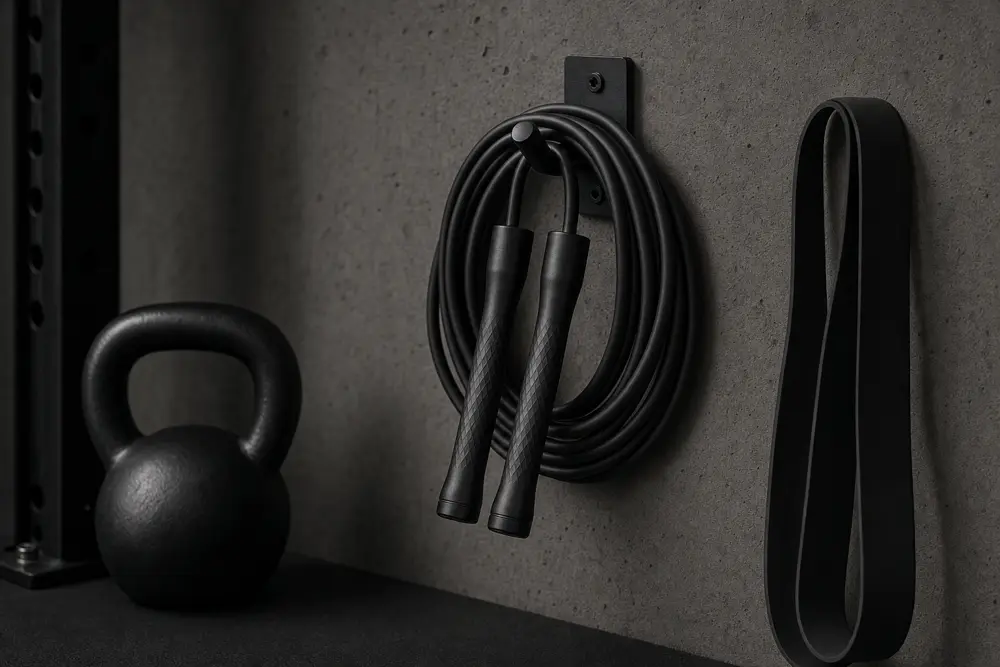
Keep the insert in the handle for the entire ladder — removing it mid-session changes your swing weight and throws off timing. If your grip starts failing before round 5, that's a sign to run the ladder without the handle weight for another week before adding it back. This is the same progression logic covered in our training blog and in the broader conditioning guide for people using the rope as their main cardio tool.
Workout 3 — Advanced: Boxing-Inspired Footwork Combos
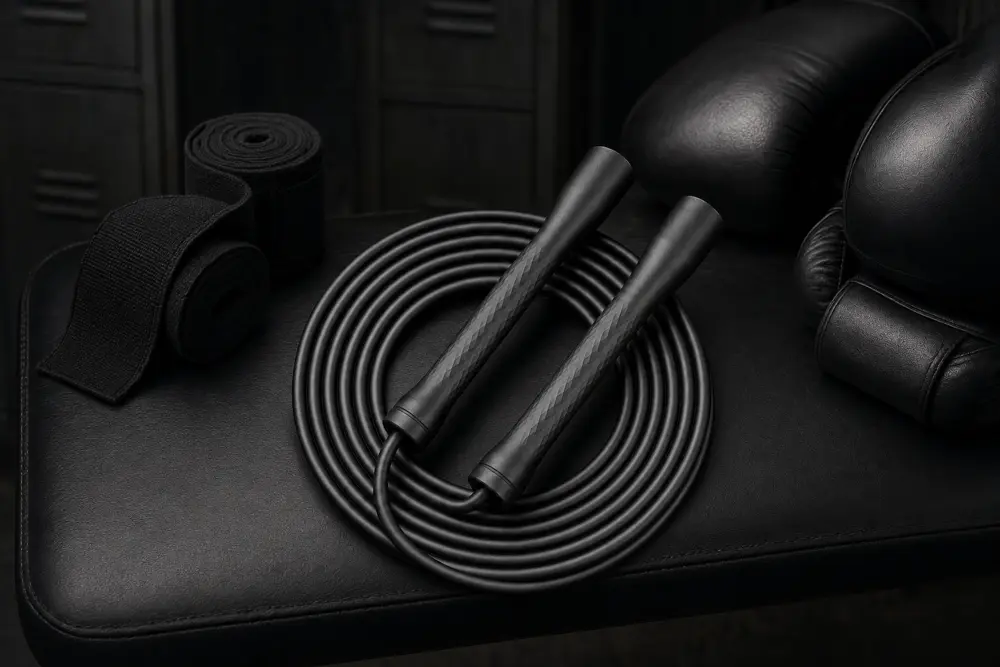
Boxing gyms have used weighted ropes for decades to build the shoulder and calf endurance that a fight actually requires, and the round structure below mirrors that training rhythm rather than a generic gym interval. Each round blends a jump rope pattern with a footwork drill so your feet stay live between combinations.
| Round (3 min) | Rope pattern | Footwork pairing |
|---|---|---|
| 1 | Basic bounce, 60s | Boxer shuffle, 60s |
| 2 | Alternate-foot step | Lateral pivot steps |
| 3 | High knees, 45s bursts | Slip-and-step drill |
| 4 | Double-under attempts | Forward-back shuffle |
| 5 | Freestyle mix, athlete's choice | Combine footwork + rope, no pause |
Rest one minute between rounds, same as a fight-camp bell. Round 5 is the test: keep the rope moving while you drill footwork instead of doing the two separately. Many trainers use this pairing because it forces the same rhythm and hand-eye timing that shows up in the ring, though we're not claiming any specific calorie or strength outcome — just what coaches and our own testers consistently report.
Which Routine Should You Start With?
The biggest mistake we see reported in buyer feedback is skipping straight to the thick cable with the handle weight inserted before the wrist and forearm adapt. One verified buyer noted the cables are "quite heavy" compared to a standard rope — which is the point, but only once your base rhythm is solid.
By the Numbers
verified reviews behind the Ironpace Dual Cable System
— Ironpace order history, 2026
Ironpace ropes sold to date
— Ironpace sales data, 2026
average rating across verified buyer feedback
— Ironpace order history, 2026
Gear Notes for These Three Workouts
All three routines assume the same rope: adjustable weight inserted or removed at the handle, plus a choice between the thin and thick cable. Nothing here requires buying separate equipment for each level — you're just changing cable and insert combinations as you progress. Read our how we test page for the exact process Derek uses to evaluate bearing smoothness and cable swap speed across training blocks.
For a deeper look at how handle weight and cable choice affect intensity, see our guide on choosing the right handle and cable weight, and check verified buyer reviews to see how other athletes structured their first month.
Every Ironpace rope ships with free shipping and a 30-day money-back guarantee, so you can run all three routines above risk-free. Questions about which cable to start with? Reach out to our team — read more about the brand on our about page.

Derek Malone · Strength coach & product lead at Ironpace
Derek has coached boxing and CrossFit conditioning for over a decade. He tests every rope Ironpace sells through real training blocks — bearing smoothness, cable swap speed, handle grip, and how the weight actually feels after 500 reps.